
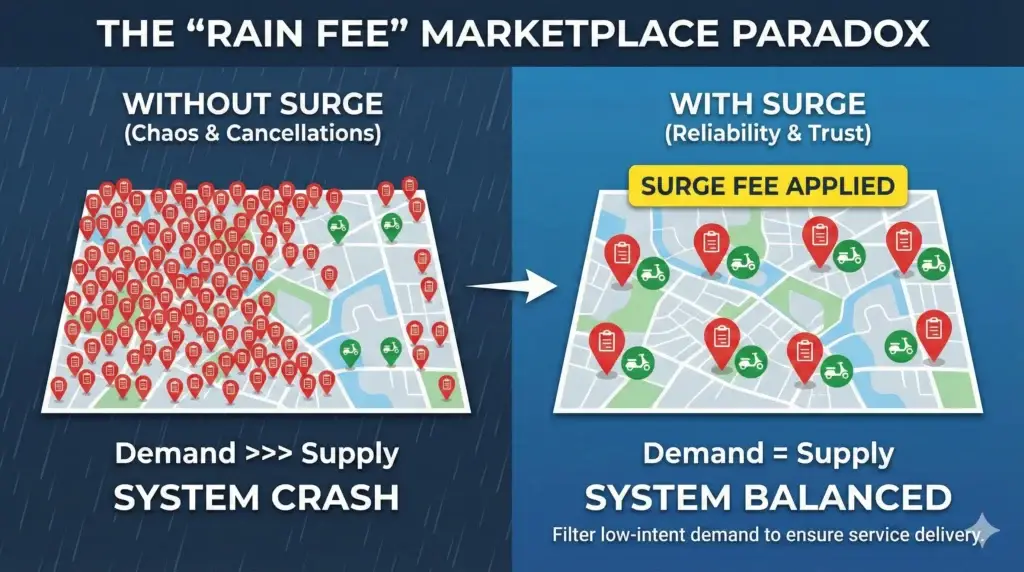
The User Anger
It is 8 PM. It is pouring rain. You are hungry. You open your food delivery app, and there it is: A text banner saying “Service is impacted due to rain” and a surge fee of ₹50 added to your cart.
You feel annoyed. You think, “These platforms are ruthless. They see us stuck at home and decide to price gouge.”
But let’s flip the table and look at this from the Product Manager’s dashboard.
The “Death Spiral” of the Marketplace
A hyperlocal marketplace like Swiggy, Zomato, or Uber relies on Liquidity: the balance between Supply (Riders/Drivers) and Demand (You).
When it rains, two things happen simultaneously:
- Supply Crash: Riders log off. It is dangerous to drive two-wheelers in rain, or they simply don’t want the hassle. Supply drops by 40-50%.
- Demand Spike: Consumers who would usually walk to a restaurant or cook decide to order in. Demand jumps by 200%.
The “No-Fee” Scenario:
Imagine the PM decides to be “nice” and not charge a fee.
- 1,000 customers place an order because the price is normal.
- There are only 100 riders on the road.
- The system assigns the first 100 orders.
- The other 900 orders sit in “Searching for Delivery Partner” status for 60 minutes.
- Eventually, those 900 orders get cancelled.
The Result:
900 furious customers who starved for an hour. They lose trust in the platform. They churn.
The Solution: Supply Shaping (The Filter)
The Product Manager has a tough choice:
- Option A: Let everyone order and fail 90% of them (Bad Experience).
- Option B: Discourage 80% of people from ordering so we can serve the remaining 20% perfectly (Reliability).
The “Rain Fee” is Option B.
It is a tool called Supply Shaping. By adding a price friction (the fee), the platform filters out “Low Intent” users—those who are annoyed by the fee and decide to just eat leftovers or cook noodles.
This drops the demand from 1,000 down to, say, 150. Now, the 100 riders can service those 150 orders with a reasonable ETA.
The platform isn’t trying to make an extra ₹50 from you. They are trying to ensure that if they take your order, they can actually deliver it.
The PM Lesson: Quality of Service (QoS) > Volume
In the early days of a startup, you want maximum users. But at scale, Reliability is the product.
If you are a B2B PM, you see this in API Rate Limits. If you are a SaaS PM, you see this in “Enterprise Priority Support.”
Sometimes, you have to “fire” some customers (temporarily) to prevent the entire system from crashing for your best customers.
The “Rain Fee” isn’t greed. It is the price of reliability.