
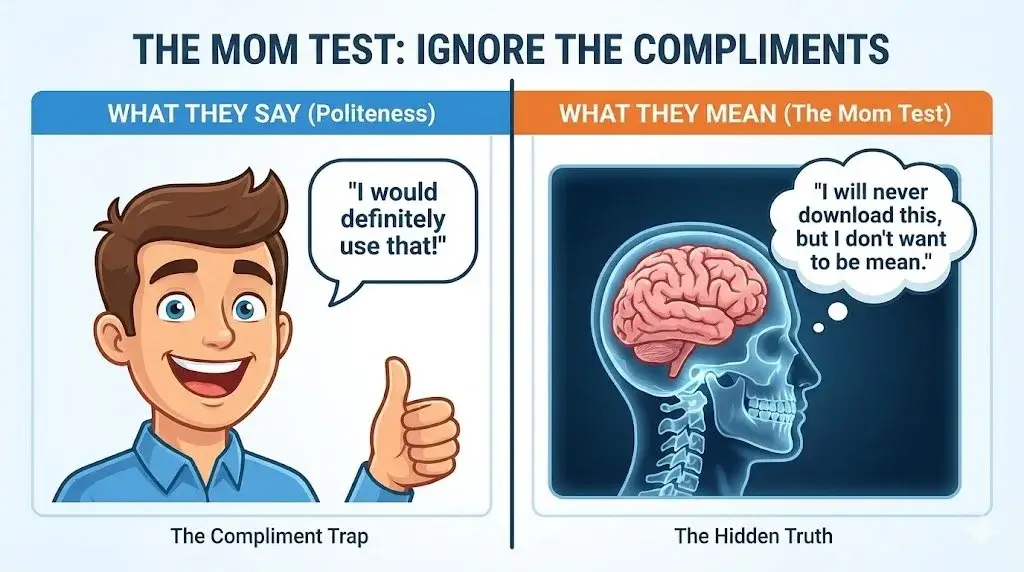
The “Pitching” Trap
As founders, we love our ideas. When we talk to potential customers, we naturally go into “Sales Mode.”
- “It’s like Uber for Dog Walking!”
- “It uses AI to optimize your calendar!”
The moment you start pitching, the data is ruined. The other person enters “Polite Mode.” They compliment you to end the conversation. You walk away thinking you have a winner. Six months later, you launch, and cricket sounds.
The 3 Rules of The Mom Test
Rule 1: Talk about their life, not your idea. You are a detective, not a salesman. If you are building a tool for freelance writers, don’t say: “I’m building a billing tool for writers.” Say: “How do you currently handle your invoices?”
Rule 2: Ask about specifics in the past, not generics in the future. Humans are terrible at predicting the future. We all want to be the person who goes to the gym, eats salad, and buys your productivity app.
- Bad Question: “Would you pay $10 for this?” (Answer: Yes, in their imagination).
- Good Question: “Have you ever paid for a tool to solve this problem before?” (Answer: The truth).
If they say it’s a “huge problem” but they haven’t tried to solve it (even with a spreadsheet), it’s not actually a problem. It’s just a complaint.
Rule 3: Talk less, listen more. If you are talking more than 50% of the time, you are failing. You should be asking “Why?” and “Tell me more about that.” The customer owns the problem. You own the solution. Don’t mix them up.
The “Commitment” Check
How do you know if they are telling the truth? Ask for Commitment. If someone says, “I love this idea!”, ask for something valuable:
- Time: “Can we meet for 1 hour next week to go over the prototype?”
- Reputation: “Can you introduce me to your boss?”
- Money: “We are taking $50 deposits. Do you want to secure your spot?”
If they hesitate, their earlier praise was a lie. Real validation stings a little.
Conclusion
Building a portfolio of lifestyle businesses is about batting average. You want to kill the bad ideas fast (in the conversation stage), so you only write code for the good ones. Don’t ask your Mom if she likes it. Ask her how much she paid for her last solution.