
The Observation
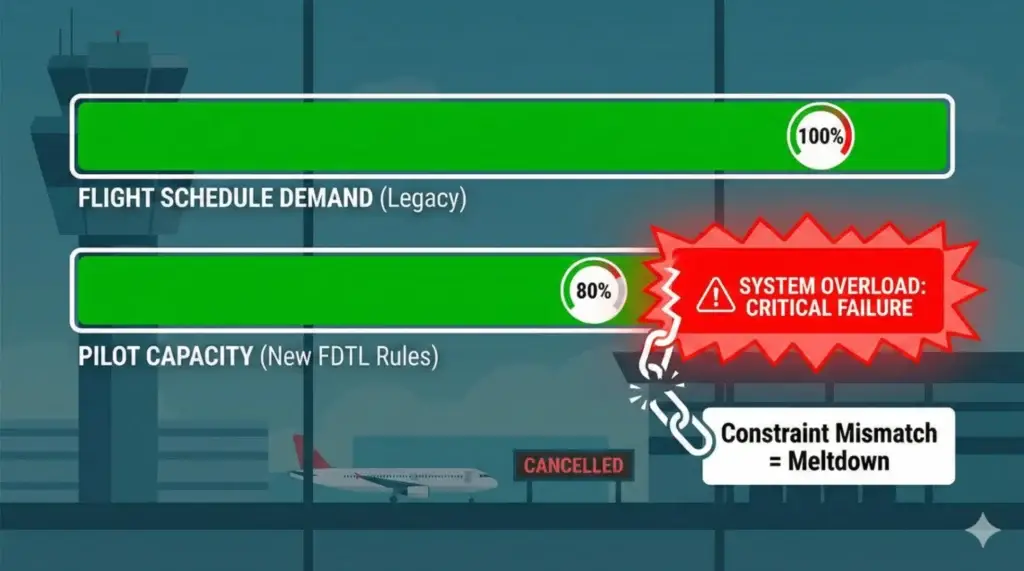
We are witnessing an operational meltdown in Indian aviation. Flights are cancelled, pilots are exhausted, and passengers are stranded. The media is blaming the dense fog. But if you look closer, the fog was just the trigger. The gun was loaded by the new DGCA Flight Duty Time Limitations (FDTL) norms introduced in January 2024.
IndiGo, a machine built for precision, suddenly looked like it didn’t know how to run an airline. Why? Because the underlying logic of their resource allocation broke overnight.
The Root Cause: Constraint Updates vs. Legacy Models
In Product Management terms, the DGCA released a “Patch Update” to the aviation operating system.
- The Update: Pilots now need 48 hours of weekly rest (up from 36). Night duty limits are stricter.
- The Impact: The “utilization rate” of a single pilot dropped. The asset (the pilot) is now available for fewer hours per week.
The Math Problem:
If you have 1,000 flights to fly, and you previously needed 3,000 pilots, under the new rules, you might need 3,600 pilots to fly the same 1,000 flights.
The Strategic Failure:
IndiGo (and others) faced a classic Tech Debt scenario. They tried to run their “Legacy Schedule” (designed for old rules) using the “New Constraints.” They didn’t hire enough new pilots in time (Lead time for pilot training is high). They didn’t cut the flight schedule significantly to match the new capacity.
They ran the system at >100% theoretical capacity. When the fog hit (a minor random variable), the system had zero buffers left. Pilots timed out faster than ever before because the new rules forced them to clock out earlier.
How It Could Have Been Avoided (Capacity Planning)
This is a lesson in Resource Capacity Planning. When a constraint changes, you have two choices:
- Scale Resources: Hire 20% more staff immediately (Expensive, slow).
- Throttling: Reduce the throughput (Cut flights) to match the new limit.
IndiGo tried to do Option 3: Hope. They hoped they could squeeze the existing roster to fit the new rules. A good Product Strategy would have been to accept a short-term dip in revenue (cancel 10% of the schedule proactively) to maintain System Integrity (Reliability).
Instead, they protected the Schedule and broke the Network.
The Competitor Landscape: Short-Term Greed
Competitors like Air India saw this chaos and reacted with Dynamic Pricing algorithms on steroids. Prices shot up to ₹50k+ for domestic sectors.
- The Mistake: This is “Surge Pricing” without “Surge Value.” Uber charges surge pricing to bring more drivers on the road (supply response). Air India charged high prices just because they could (rent-seeking).
- The Missed Opportunity: A competitor could have marketed “The FDTL-Compliant Schedule.” They could have said, “We adjusted our flights to give our pilots rest, so your flight won’t be cancelled.” They could have sold Certainty in a market of chaos.
Conclusion
The DGCA didn’t break the airlines. The airlines broke themselves by refusing to adapt to the new reality.
The Takeaway for PMs:
When the “Rules of the Game” change (GDPR, Apple Privacy changes, RBI guidelines), you cannot run your old playbook. You must refactor your capacity model. If you try to force old efficiency into new constraints, you don’t get efficiency—you get a meltdown.