
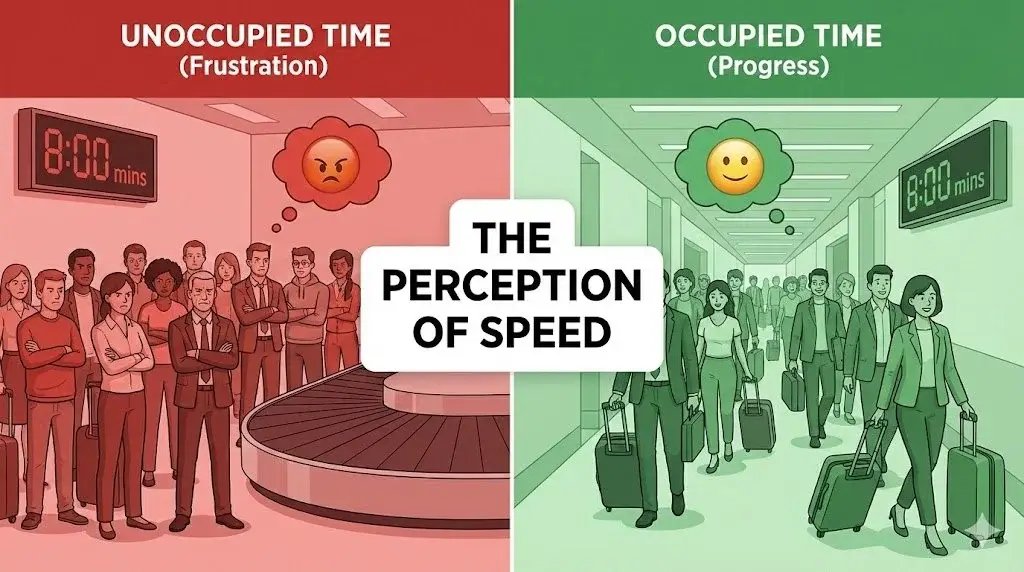
The Houston Experiment
The Houston Airport story is the foundational case study for the Psychology of Queuing. The airport realized that the objective variable (Time) mattered less than the subjective variable (Perception). When passengers were standing at the carousel staring at an empty belt, they were bored and anxious. They felt ignored. When they were walking, they were “working” toward a goal. They felt in control.
The Maister Principles
David Maister, an expert on business management, formulated several laws of waiting:
- Unoccupied time feels longer than occupied time. (The Baggage Claim).
- Anxiety makes waits seem longer. (Why Uber shows you the car moving on the map—so you know it’s actually coming).
- Unexplained waits are longer than explained waits. (“Your train is delayed” vs. “Your train is delayed due to signal failure”).
Applying this to Product Management
As PMs, we often obsess over engineering latency. We want to reduce API response time from 400ms to 200ms. That is important. But Perceived Performance is often cheaper to fix and yields better results.
1. The Skeleton Screen (Facebook/LinkedIn) Notice how when you open LinkedIn, you don’t see a spinner? You see a gray, pulsing outline of the feed. This is a trick. It tricks your brain into thinking the content is already there, it’s just rendering. It makes the wait feel active (“It’s loading!”) rather than passive (“It’s stuck”).
2. The “Fake” Progress Bar (TurboTax) When you file taxes online, sometimes the software shows a progress bar saying: “Checking for deductions… scanning charity donations… reviewing business expenses…” Often, the calculation is already done instantly. The software slows down intentionally to show you these steps. Why? Because if it finished in 0.1 seconds, you wouldn’t trust that it did a thorough job. The “Occupied Wait” builds trust.
3. Gamified Waiting (Chrome Dinosaur) Google Chrome turned the frustration of “No Internet” into a game (The Dinosaur Run). It occupies your mind so you don’t get angry at the browser while the connection resets.
Conclusion
You cannot always make your backend faster. Sometimes databases are slow. Sometimes networks are laggy. But you can always make the wait feel shorter. Don’t let your users stare at an empty carousel. Give them a walk.