
The Stress of the Search
Booking a holiday should be fun. Yet, navigating modern travel websites often feels like a high-stakes trading floor.
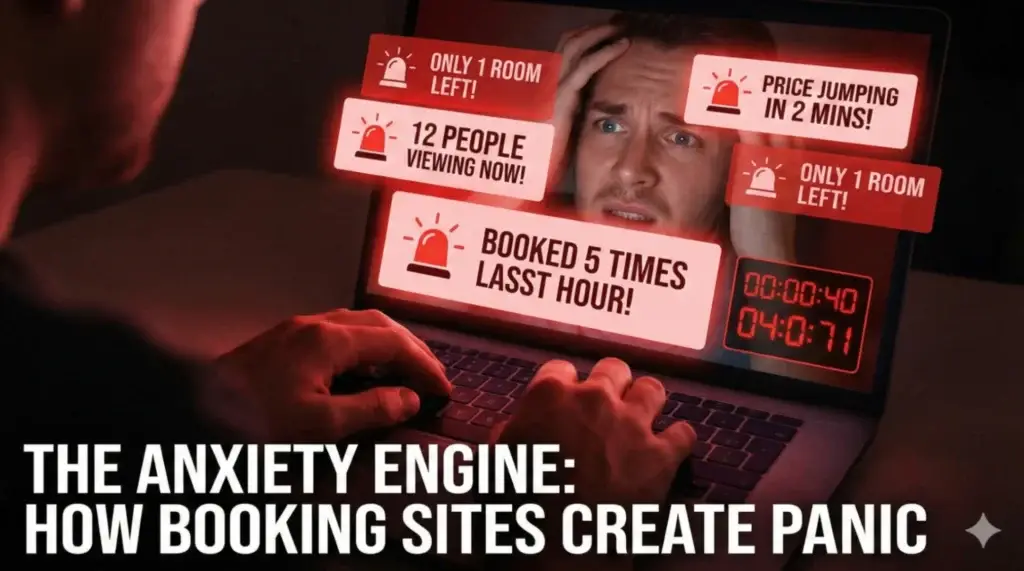
I recently tried to book a weekend getaway. Within seconds of landing on a hotel page, the UI started screaming at me. Red text. Flashing icons. Pop-ups showing recent bookings from “Someone in Germany.”
I wasn’t being helped to make a decision; I was being pressured into one.
The Psychology Toolkit: Scarcity and Social Proof
These sites are masters of applied behavioral economics, heavily relying on the principles popularized by Dr. Robert Cialdini.
1. Artificial Scarcity (The FOMO Trigger)
- The Tactic: “Only 2 rooms left!” or “This price expires in 10 minutes!”
- The Psychology: Humans are highly Loss Averse. The pain of missing out on a deal is psychologically twice as powerful as the pleasure of finding one. By framing the inventory as vanishing, the platform forces you to act now rather than “think about it later.”
2. Weaponized Social Proof (The Herd Mentality)
- The Tactic: “15 people are looking at this right now” or “Someone from London just booked this.”
- The Psychology: When we are uncertain (e.g., “Is this a good hotel?”), we look to others for guidance. If 15 other people want it, our brain assumes it must be good. It creates a competitive instinct—you want to beat those 15 invisible competitors to the prize.
The PM Dilemma: Helpful Feature vs. Dark Pattern
For a Product Manager owning conversion metrics, these tactics are gold mines. A/B tests almost always show that adding urgency elements increases bookings.
But there is an ethical boundary, often referred to as “Dark Patterns”—UI designs meant to trick or coerce users into doing things they didn’t mean to.
The “Helpful” Boundary: If the hotel genuinely only has 2 rooms left for those dates, telling the user is a service. It helps them avoid disappointment. This is transparent data.
The “Dark Pattern” Boundary: If the site says “Only 2 rooms left!” but that’s just a generic message shown when inventory is below 50%, or if the “15 people looking” includes people who closed the tab an hour ago, it’s manipulation. It’s creating false anxiety to juice metrics.
The Long-Term Cost
While these tactics boost short-term conversion, they have a long-term cost: Trust Debt.
If users start feeling bullied by your interface, they eventually become numb to the warnings or, worse, migrate to a platform that feels more honest (like Airbnb, which generally uses softer tactics).
The Takeaway: As PMs, we should use psychology to help users make decisions faster, not to terrorize them into spending money. Optimize for conversion, yes, but never at the expense of trust.