
As we approach 2030, the “Ultimate Summit” has turned out to be a plateau.
The recently released World Economic Forum (WEF) Future of Jobs Report 2025 provides a sobering look at the skills that will actually define the next five years. When you look at the data, one thing is clear: the era of the “Syntax Specialist” is ending, and the era of the “Agile Orchestrator” has begun.
1. The Jensen Huang Shift: Redefining “Smart”
NVIDIA CEO Jensen Huang recently sparked a firestorm by suggesting that the smartest people in the room should no longer focus on programming. He argued that in the past, we had to learn how to speak “Computer” (C++, Java, Python) to be productive. Today, the computer has finally learned to speak “Human.”
This has fundamentally changed the definition of professional intelligence. Historically, “smart” was synonymous with the ability to memorize complex syntax or optimize a specific algorithm. Today, that is a commodity. As Jensen points out, true “smart” is now defined by domain expertise and problem decomposition—the ability to look at a complex human mess and break it down into instructions an AI can execute.
2. Decoding the Data: The Decline of the Syntax Wizard
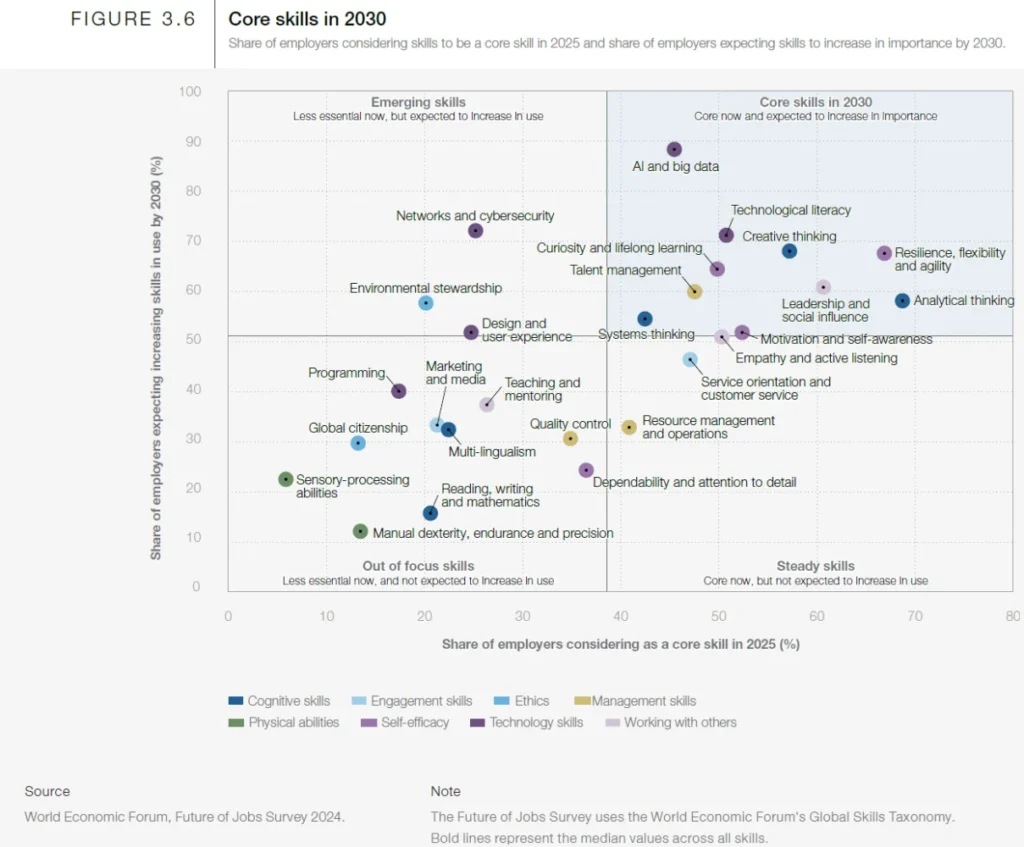
If you look at the WEF 2025 skill quadrant, the placement of Programming is the most contrarian takeaway. It has drifted into the lower-left quadrant: “Out of Focus Skills.”
Why? Because of the Low-Code/No-Code revolution.
- 2015: You needed a team of three to build a functional web app.
- 2025: A Product Manager with a novice understanding of logic can prompt an AI to generate the boilerplate, deploy the CSS, and set up the database in an afternoon.
The “Hard Skill” of writing code is becoming a baseline utility, like typing or using a spreadsheet. It’s no longer a competitive advantage; it’s an entry requirement.
3. The New Moat: Cognitive Skills and the “Human Advantage”
If programming is declining, what is taking its place in the high-growth, high-importance quadrant? Cognitive Skills.
- Analytical Thinking: Currently the most widespread core skill, and it isn’t going anywhere. AI can provide answers, but it struggles to ask the right questions. The ability to analyze why a customer is churning is infinitely more valuable than writing the script to export the churn data.
- Creative Thinking: This is positioned high on the vertical axis (growth). AI is a “re-mixer” of existing human knowledge. It is excellent at the average, but terrible at the “New.” Creative thinking—the ability to imagine a solution that has no precedent—is the ultimate insurance against automation.
- Systems Thinking: As we move toward a world of interconnected AI agents, the ability to see the “Big Picture” becomes critical. You aren’t just managing a task; you are managing a complex ecosystem of human and digital actors.
4. Self-Efficacy: The Meta-Skill for a Volatile Market
Perhaps the most overlooked section of the WEF report is Self-Efficacy. This includes Resilience, Flexibility, and Agility.
In a market where the “Hot Tech Stack” changes every six months, your most valuable asset isn’t your current knowledge—it’s your Rate of Learning.
- Curiosity and Lifelong Learning: This is the “fuel” for the 2030 professional. If you are a developer who refuses to use No-Code tools, you are a dinosaur. If you are a Product Manager who is afraid to get your hands dirty with AI-assisted automation, you are obsolete.
- The Agility Advantage: Resilience isn’t just about “working hard.” It’s about the emotional intelligence to see your core skill be automated, and instead of panicking, asking: “How can I use this new free time to solve a bigger problem?”
5. Conclusion: From Creator to Orchestrator
The 2030 professional is not a “Specialist” in the traditional sense. They are an Orchestrator.
They use No-Code tools to build micro-platforms, AI to handle the “grunt work” of data processing, and their own Cognitive and Self-Efficacy skills to ensure the project actually delivers value.
We are moving back to a world where the “smartest” people are the ones who understand human needs, not machine languages. The barrier to entry has never been lower, but the bar for true excellence has never been higher. Don’t just learn a tool; learn how to think, how to pivot, and how to solve problems that don’t have a Google-able answer.