
The Universal Frustration
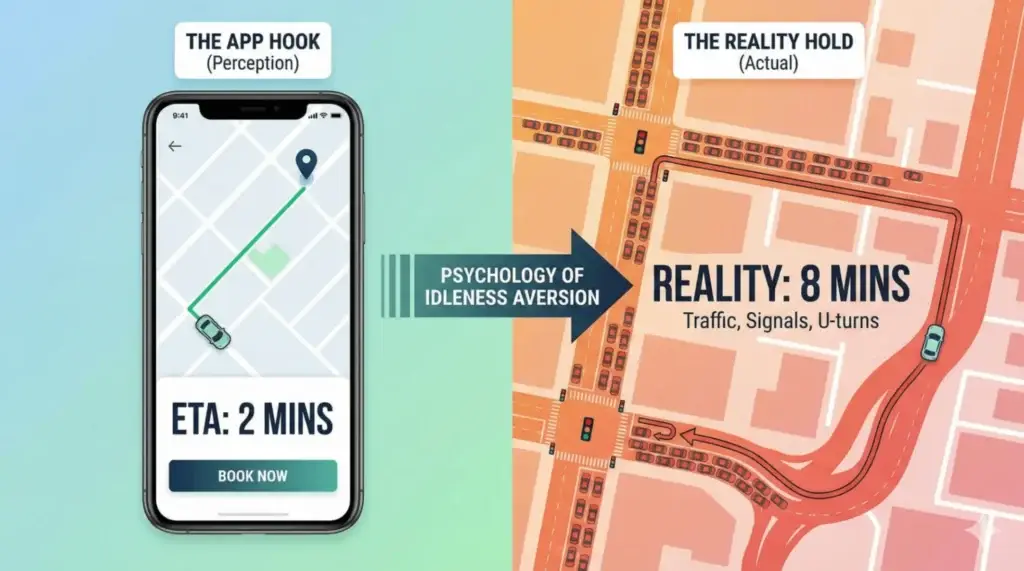
It’s 9 AM. You are late for a meeting. You whip out your phone to book a cab. The map shows plenty of cars around you. The text says, “Pickup in 2 minutes.” Relieved, you hit “Confirm Booking.”
Swish. The screen refreshes. Your driver has been assigned. And suddenly, that “2 minutes” has turned into “Arrival in 8 minutes.”
You stare at the screen, annoyed. You feel tricked. You wonder if their algorithm is broken.
It’s not broken. It’s working exactly as designed.
The Psychology of Waiting (Idleness Aversion)
To understand why this happens, we need to look at behavioral psychology. Humans have a deep-seated cognitive bias called Idleness Aversion.
We absolutely hate waiting when we don’t know why we are waiting or how long it will take.
- Scenario A: You wait 5 minutes for a bus, but the digital sign says “Bus arriving in 5 minutes.” You are calm.
- Scenario B: You wait 3 minutes for a bus with no sign and no information. You are anxious and frustrated.
Even though the wait is shorter in Scenario B, the experience is worse because of the uncertainty.
The “Hook and Hold” Strategy
Cab aggregators use this psychology to manage a two-step funnel:
Step 1: The Hook (Conversion Rate Optimization)
Before you book, you are a “shoppers.” You are comparing Uber vs. Ola vs. Rapido. The primary metric here is Conversion. The friction point is the wait time. If the app honestly tells you “8 minutes,” you might check a competitor. So, the algorithm shows you an “optimistic average”—the best-case scenario (2 mins) to reduce friction and get you to tap that “Book” button.
Step 2: The Hold (Managing Expectations)
Once you book, you are converted. You have skin in the game. The friction to cancel and switch apps is now higher than the pain of waiting. Now, the app needs to manage your Idleness Aversion. It needs to give you certainty. So, it shows you the real time (8 minutes) and shows you the little car moving on the map. Watching the car move gives you a sense of progress, pacifying your anxiety about waiting.
They hooked you with optimism and held you with certainty.
The PM Lesson: Perceived vs. Actual Performance
This isn’t just about cabs. This is a crucial lesson for building digital products: Perceived speed matters more than actual speed.
If your backend takes 10 seconds to generate a report, you can’t just show a blank white screen for 10 seconds. The user will think the app crashed.
You have to manage the perception:
- Skeleton Screens: Show a greyed-out outline of the page layout instantly, before the data loads. It feels faster.
- Fake Progress Bars: Many loading bars don’t actually measure progress; they just move at a constant speed to tell you, “Don’t worry, I’m working.”
- The “Spinner”: The spinning wheel isn’t functional; it’s an “anxiety reduction widget.”
Conclusion
The next time your cab ETA jumps from 2 to 8 minutes, don’t blame the GPS satellite. Blame behavioral economics.
The product isn’t lying to you; it’s managing your anxiety to ensure you don’t abandon the funnel.
The Takeaway
Don’t just optimize your backend latency. Optimize the user’s waiting experience. A slow product with great feedback feels faster than a fast product with zero feedback.