
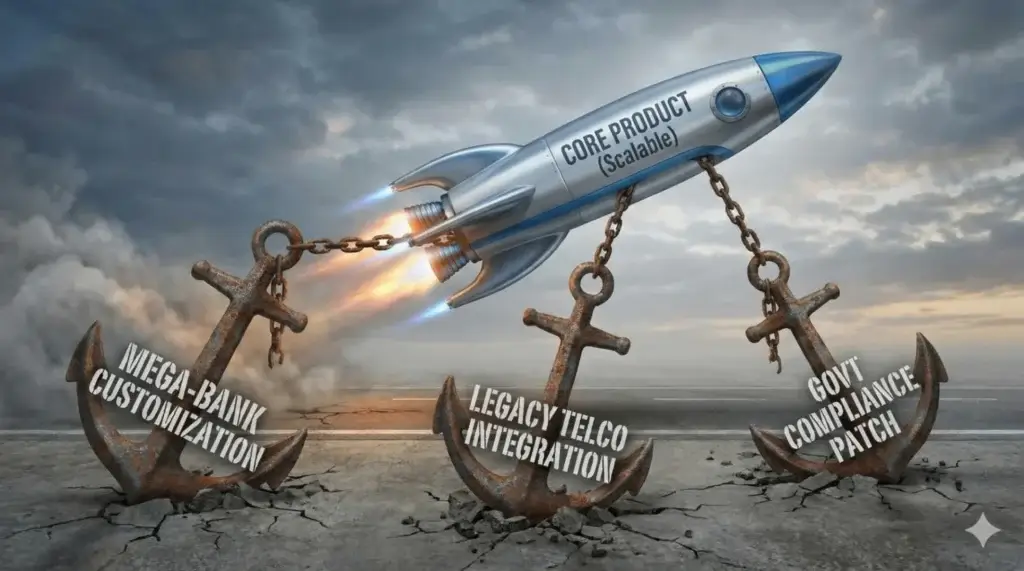
The Siren Song of the Enterprise Deal
In the early stages of a B2B startup, revenue is oxygen. When a massive enterprise client (a bank, a telco, a government agency) shows interest, it is intoxicating. It validates your existence.
But these “Elephants” or “Whales” rarely buy off-the-rack. They demand tailoring.
- “We need this specific report format.”
- “We need an on-premise deployment option.”
- “We need this button to be blue, not green.”
The pressure to say “Yes” is immense. The sales team’s commission depends on it. The CEO wants to show growth to investors.
So, Product caves. You build the custom feature.
The Economics of “Bad Revenue”
Why is this a problem? Money is money, right? Wrong. In SaaS, there is such a thing as “Bad Revenue.”
When you build a custom feature hardcoded for Client A:
- Zero Scalability: That code is useless to Clients B, C, and D. Your R&D investment has an ROI of 1.
- Exploding Tech Debt: You now have a fork in your code. Every time you update the core product, you have to test and ensure you haven’t broken Client A’s custom franken-feature. Maintenance costs soar.
- Opportunity Cost: The 6 weeks your best engineers spent building that custom report is 6 weeks they didn’tspend building the game-changing feature that would have attracted 1,000 smaller customers.
You are slowly transforming from a high-margin Product company (build once, sell twice) into a low-margin Services company (build once, sell once).
The PM Solution: The Platform Pivot
So, what do you do when the $1 Million deal is on the table? You cannot just be the “Department of No.”
You have to act like a Diplomat (remember our previous blog?). You need to pivot the conversation from “building a feature” to “providing a capability.”
The Strategy: Don’t give them the fish; give them the fishing rod.
If the big bank wants a custom integration with their legacy mainframe:
- The Services Trap (Bad PM): “Okay, our team will spend 2 months building that specific connector for you.”
- The Platform Play (Good PM): “We won’t build that specific connector. However, we will accelerate our roadmap to build a robust Public API and Webhooks infrastructure. Your IT team (or a third-party partner) can use that API to build whatever integration you need.”
Why this works:
- You get the revenue: The client gets their problem solved.
- You stay scalable: The API you built is a generic asset that all future clients can use.
- You shift the burden: The maintenance of the custom logic sits with the client, not you.
Conclusion
Closing big deals is exciting. But as a Product Manager, your job is to ensure that today’s big deal doesn’t become tomorrow’s straitjacket.
Defend the roadmap. Build platforms, not patches.