The Indestructible Moat
In 2016, Instagram launched “Stories.” It was a carbon copy of Snapchat. Snapchat had the innovation. They invented the format. But Instagram won. Why? Because Instagram had the Network. Your friends were already on Instagram. You didn’t want to open a second app just to post a disappearing photo.
Features are cheap. Any developer can copy your code in a month. But nobody can copy your user base. This is why Network Effects are the ultimate defense.
The Three Types of Network Effects
1. Direct Network Effects (The Telephone) This is the simplest form. An increase in usage leads to a direct increase in value for other users.
- Examples: WhatsApp, Facebook, Slack.
- The Metric: “Time to Connect.” (How fast can I find my friend?)
2. Two-Sided Network Effects (The Marketplace) This involves two distinct groups: Supply and Demand. The value for one group depends on the size of the other group.
- Example: Uber.
- Riders don’t care how many other riders there are. They care how many Drivers there are.
- Drivers care how many Riders there are.
- The Trap: This is the hardest to build because of the “Chicken and Egg” problem. (You can’t get riders without drivers, and you can’t get drivers without riders).
3. Data Network Effects (The Algorithm) This is the modern moat. The more users you have, the more data you collect, and the smarter your product becomes.
- Example: Google Maps / Waze.
- Every user driving with Waze is a data sensor. They make the traffic prediction better for everyone else.
- A new competitor cannot just buy a map; they need the live traffic data that only comes from having users.
The Cold Start Problem
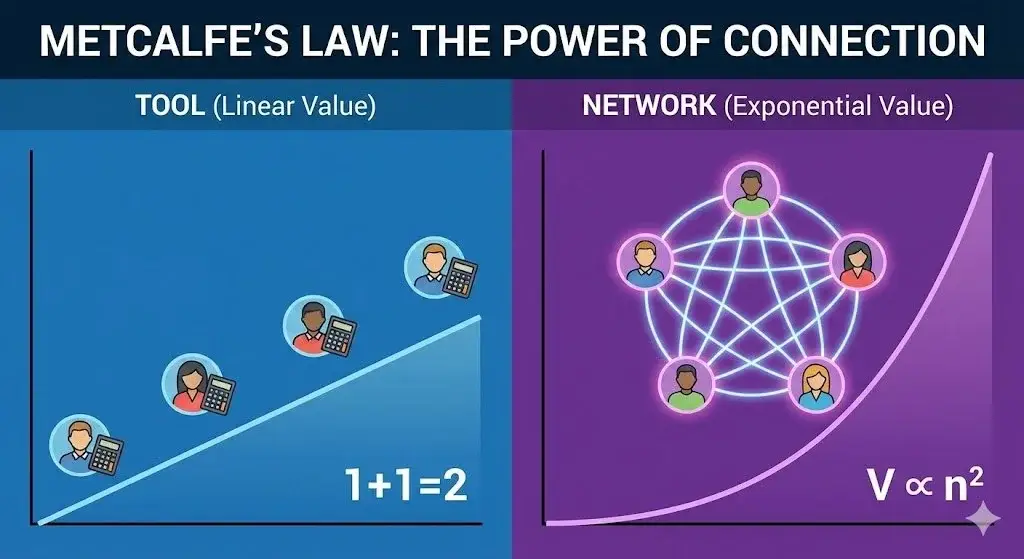
If Network Effects are so great, why doesn’t everyone have them? Because the beginning is brutal. This is the Cold Start Problem (coined by Andrew Chen). When n is small, the value (n2) is near zero. The “Fax Machine” is useless.
How to solve it?
- Start in Single-Player Mode: Build a tool that is useful even without the network.
- Instagram started as a cool photo filter tool (Single Player). The social network came later.
- Focus on the “Atomic Network”: Don’t launch to the world. Launch to one tiny campus (Facebook at Harvard) or one city (Uber in SF). Reach “Critical Mass” in a small pond before moving to the ocean.
Conclusion
If you want to build a small, profitable lifestyle business, build a Tool. It’s easier to sell and easier to market. If you want to build a Unicorn, you must eventually transition that Tool into a Network. Don’t just build for the user. Build for the connection between users.