
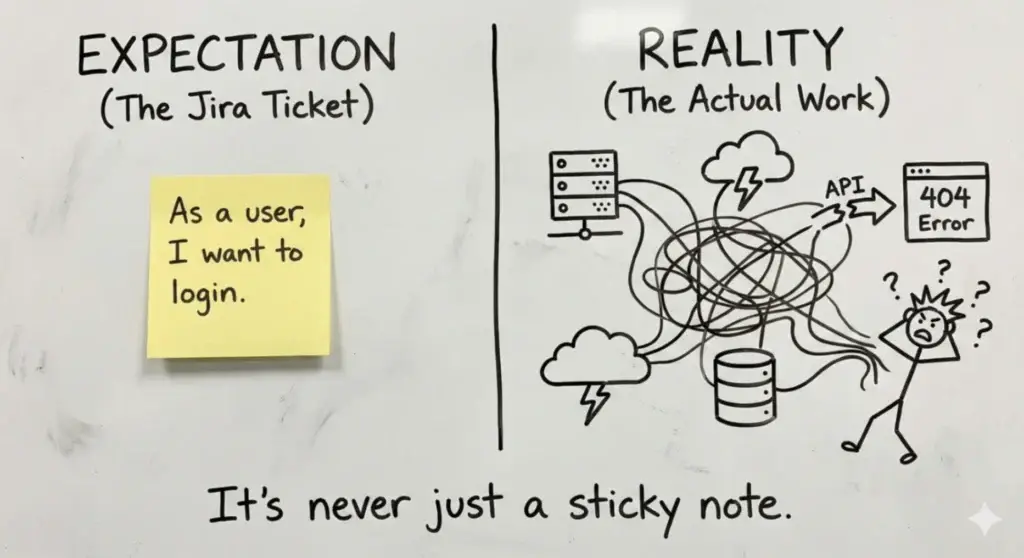
The Problem A QA Analyst walks into a bar and orders -1 beers. The bartender crashes. Why? Because the User Story said “User can order beers” but didn’t say “User cannot order negative beers.”
Most “User Stories” I see are just requirement documents chopped into tiny, confusing pieces. They look like this:
“As a user, I want to login so that I can login.” (Thanks, Captain Obvious).
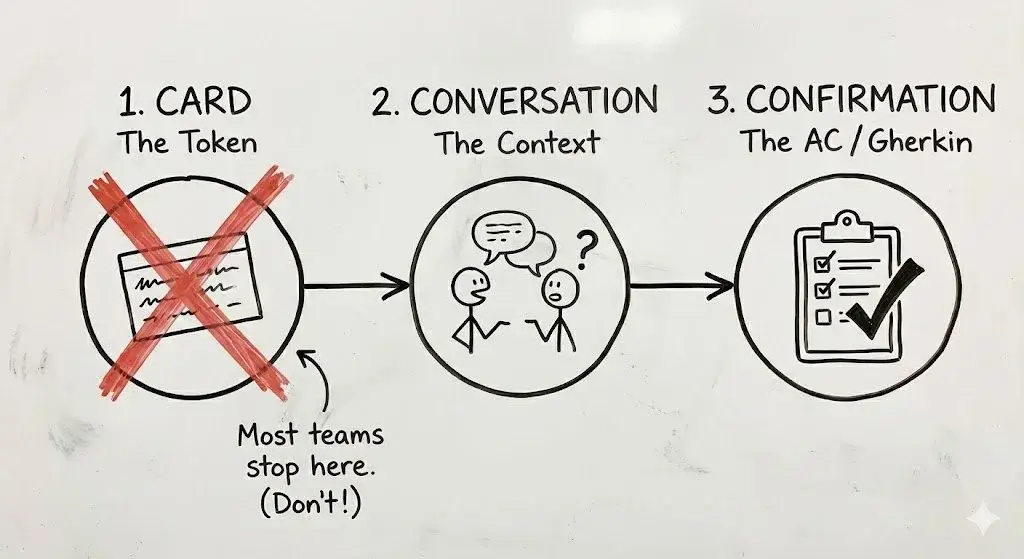
ELI5: What is a User Story actually? A User Story is not a specification. It is a placeholder for a conversation. Think of it like a token at a restaurant. The token isn’t the meal; it just proves you paid. You still have to talk to the waiter (The Conversation) to get the food (The Confirmation).
The Framework: The 3 C’s
- Card: Just enough text to identify the requirement. (The “As a…” part).
- Conversation: The discussion between the PO, Dev, and QA to clarify details.
- Confirmation: The Acceptance Criteria (AC). This is the only part the QA cares about.
The “Do’s” (For PMs/BAs)
- DO use the INVEST criteria. (If a story takes 3 weeks to code, it’s not a story, it’s an Epic failure).
- DO write Acceptance Criteria using Gherkin (Given/When/Then).
- DO include the “Why.” Developers code better when they know why a feature exists.
The “Don’ts” (For QAs/Devs)
- DON’T start coding/testing if the “Confirmation” is missing.
- DON’T accept “It should be fast” as a criteria. Define “Fast” (e.g., < 200ms).
🛠 The Lazy Story Generator
📥 Download: Simple User Story Template (.txt) Copy this into Jira/Azure DevOps description field.