
The Commodity Trap
We are living in the Golden Age of AI models. But for Product Managers, this is a trap. If you build a feature that relies solely on a public model (like a generic “Summarize this PDF” wrapper around OpenAI), you have no Moat. Any developer can clone your product in a weekend.
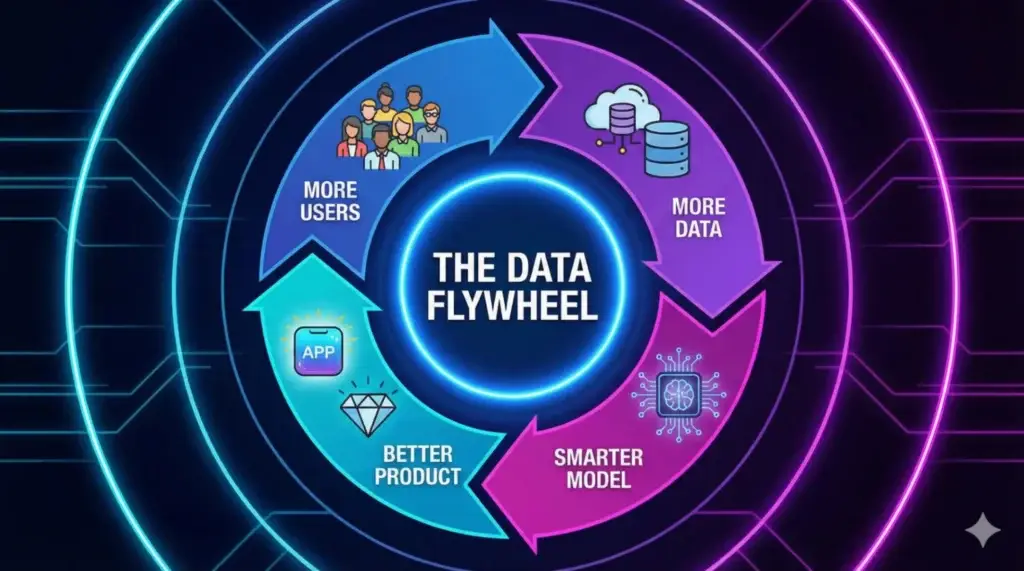
To win, you need to move from a Linear Product to a Flywheel Product.
What is a Data Flywheel?
A Data Flywheel is a system where the product gets smarter the more people use it. It converts usage into intelligence.
The Classic Example: Google Maps
- User Value: You use it to find a route.
- Data Capture: While you drive, Google captures your speed and location.
- Model Improvement: That data detects a traffic jam in real-time.
- Product Improvement: The next user is routed around the jam. The product is valuable because other people use it.
How to Build Your Own (The 3-Step Framework)
Step 1: The “Single-Player” Utility (Cold Start)
You cannot start with a flywheel. You need to attract the first user. You must build a tool that provides value even without data.
- Example: Instagram started as a simple tool to put filters on photos. It didn’t need a social network to be fun. It was a single-player utility first.
Step 2: Capture the “Data Exhaust”
Design your UI to capture data naturally. Don’t ask users to fill out forms.
- Bad PM: Sends a survey asking “Was this recommendation good?” (Low response rate).
- Good PM: Adds “Thumbs Up/Down” buttons or measures “Time Spent Reading.” If a user ignores a recommendation, that is a data point.
- Example: Netflix doesn’t ask you what you like. It watches what you watch, what you pause, and what you abandon.
Step 3: Close the Loop (Re-invest Data)
This is where the magic happens. You must feed that data back into the product to solve a problem better.
- Example: Truecaller uses the “Block” actions of 1,000 users to warn the 1,001st user about a scammer.
Case Study: The Failure of “Dumb” AI
Compare this to a “Dumb” AI product—like a standard spell checker. If I use a basic offline spell checker, it corrects my word. But my usage doesn’t help you. The product is static. Now look at Grammarly. Every time a user accepts or rejects a suggestion, their model learns nuances of tone and style. Grammarly gets smarter every day. The offline spell checker stays the same.
Conclusion
As an AI PM, stop asking, “Which model should we use?” Start asking, “How does User A’s interaction make the product better for User B?”
If your product doesn’t get better as it scales, you aren’t building an AI company. You are just renting intelligence.