
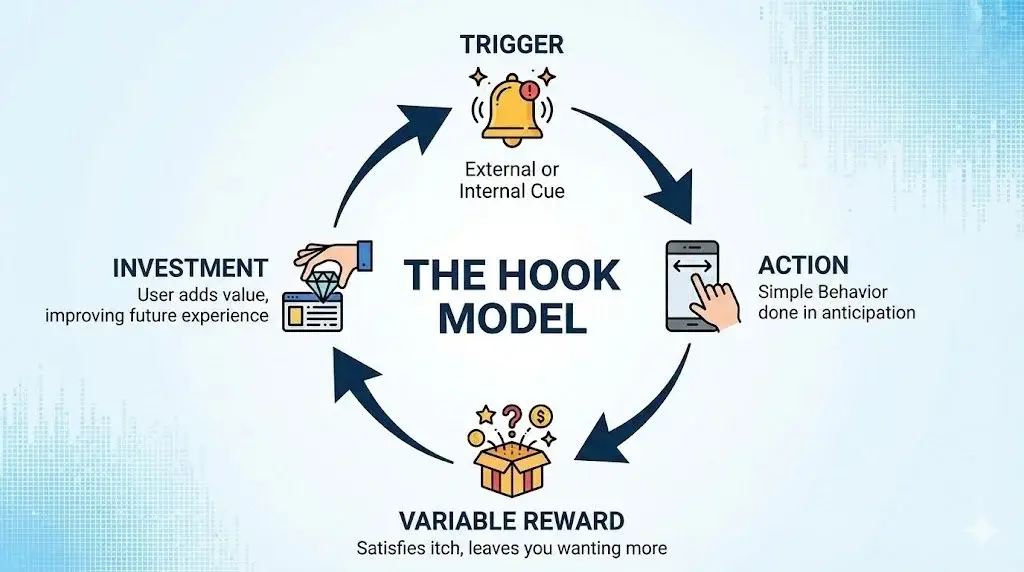
The 4-Step Loop
Why do some products flop while others become obsessions?
It’s not just “value.” It’s the delivery mechanism.
The Hook Model explains the cycle that turns a conscious choice into an automatic behavior.1
1. The Trigger (The Cue)
Every habit starts with a spark.
- External Triggers: Emails, push notifications, icons with red badges.2 These are training wheels.
- Internal Triggers: This is the goal. You want the user’s emotions to trigger the app.
- Bored? -> Open TikTok.
- Uncertain? -> Google it.
- Lonely? -> Check Facebook.
- Fear of missing out? -> Check Slack.
2. The Action (The Behavior)
Fogg’s Behavior Model states: 3$Behavior = Motivation \times Ability \times Trigger$.4
To get the action, you must make the ability high (i.e., make it incredibly easy).
- Google: Just type.
- TikTok: Just swipe.
- Amazon: One-click buy.5If the user has to think or wait, the habit breaks.
3. The Variable Reward (The Dopamine)
This is where most PMs get it wrong. They give a predictable reward.
- Predictable: Your car unlocking when you press the button. (Useful, but not addictive).
- Variable: pulling the handle on a slot machine. (Addictive).
The brain releases dopamine not when it gets the reward, but in anticipation of the reward.6
- Pinterest: You scroll because you might find a cool recipe.
- Email: You refresh because you might have good news (or a crisis).
- Uber: You watch the car because you want to see exactly where it is.
4. The Investment (The Lock-in)
This closes the loop. The user does a bit of work to improve their future experience.
- “Liking” a song on Spotify trains the algorithm to give better rewards next time.7
- Uploading a photo to Instagram triggers notifications (External Triggers) that bring you back later.
This connects back to the IKEA Effect: The more you invest, the harder it is to leave.
Conclusion: Use it for Good
The Hook Model is powerful. It is effectively mind control.
As a Product Manager, you have an ethical responsibility.
- Are you building a habit that helps the user (e.g., Duolingo, Headspace, Fitbit)?
- Or are you building a habit that exploits them (e.g., Gambling, Doom-scrolling)?Build healthy hooks.