
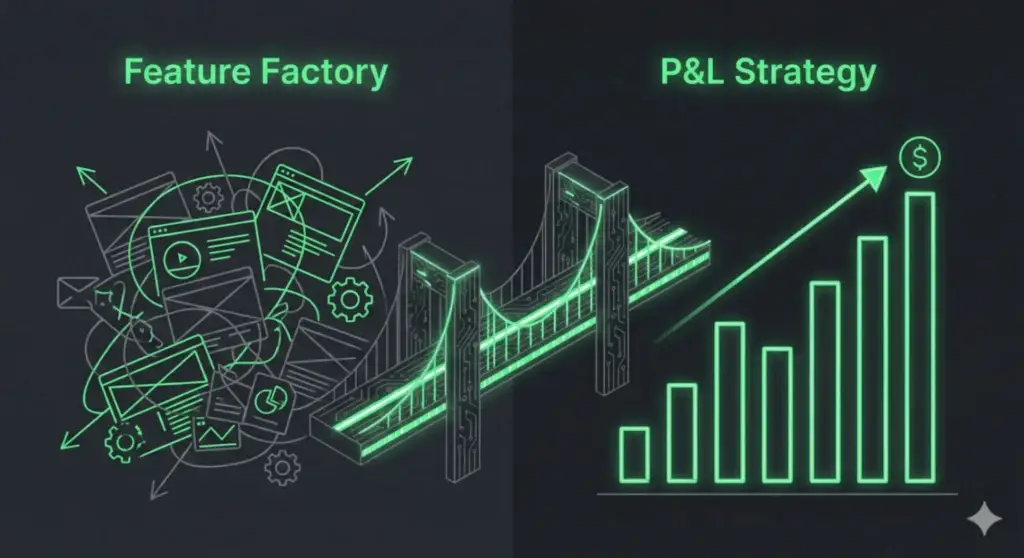
In the early stages of a Product Manager’s career, success is measured by output: features shipped, bugs fixed, and velocity maintained. But as you ascend to Principal, Director, or CPO roles, the scoreboard changes.
Your code doesn’t matter anymore. Your P&L impact does.
The most successful product leaders today act less like visionaries and more like capital allocators. They understand that every line of code is an investment that must return more than its cost of capital.
To understand this shift, we look at the definitive case study of our time: Uber’s shift from “Growth at all Costs” to “EBITDA Positive.”
Here is how Uber used three specific product levers to fix their broken P&L, and how you can apply these frameworks to your own portfolio.
Lever 1: Capital Allocation (The “Kill” Strategy)
The Scenario: For years, Uber burned billions on its Advanced Technologies Group (ATG) trying to build self-driving cars. It was a “visionary” product bet.
The P&L Reality: It was a capital sinkhole with an indefinite timeline for ROI. It dragged down the company’s overall valuation and consumed cash flow needed for the core business.
The Strategic Move: Uber sold ATG. They didn’t just stop building; they divested.
The Lesson for Principal PMs: Strategy is often what you don’t do. Look at your product portfolio today.
- Which features or products are “zombie projects”—alive, but not growing?
- Which initiatives have a Customer Acquisition Cost (CAC) that will never be repaid by their Lifetime Value (LTV)?
Actionable Framework: Conduct a “Capital Audit” of your roadmap. If a feature initiative cannot prove a path to positive margins within 12 months, kill it. Reallocate that engineering headcount (Capital) to your highest-performing product lines.
Lever 2: Revenue Expansion (The Cross-Pollination Strategy)
The Scenario: Uber had two distinct user bases: Riders and Eaters. They were treated as separate funnels.
The P&L Reality: Acquiring a customer twice (once for rides, once for food) destroys margins. High CAC eats into profitability.
The Strategic Move: Uber One. By launching a unified membership, Uber transformed its P&L. They didn’t just build a “loyalty program”; they built a mechanism to increase LTV. Data shows that Uber One members spend significantly more and retain longer than non-members.
The Lesson for Directors: Don’t just build features that solve user problems; build features that solve businessproblems.
- The Framework: Look for “Silos” in your product suite. Where can you bundle value?
- The Metric: Focus on Net Revenue Retention (NRR). How can you get $1.20 next year from the customer paying you $1.00 today without spending a dime on marketing?
Lever 3: Cost Optimization (The “SaaS-ification” of Operations)
The Scenario: Uber’s margins were historically razor-thin because they relied heavily on human support and manual driver incentives to balance supply and demand.
The P&L Reality: High OpEx (Operational Expenditure) meant that even as revenue grew, profits didn’t.
The Strategic Move: Product-led automation. Uber invested heavily in algorithmic support, improved driver onboarding flows, and ad-tech. By launching Uber Journey Ads, they introduced a high-margin digital revenue stream (Ads) into a low-margin physical business (Logistics).
The Lesson for CPOs: Your product roadmap is the biggest lever for OpEx reduction.
- The Framework: Map your “Cost to Serve.” Every time a human has to touch a ticket, or a server has to process a heavy query, your margin shrinks.
- The Strategy: Prioritize features that reduce the need for human intervention. A “Self-Serve Refund” feature might not be sexy, but if it reduces support volume by 15%, it is more valuable to the P&L than a shiny new UI update.
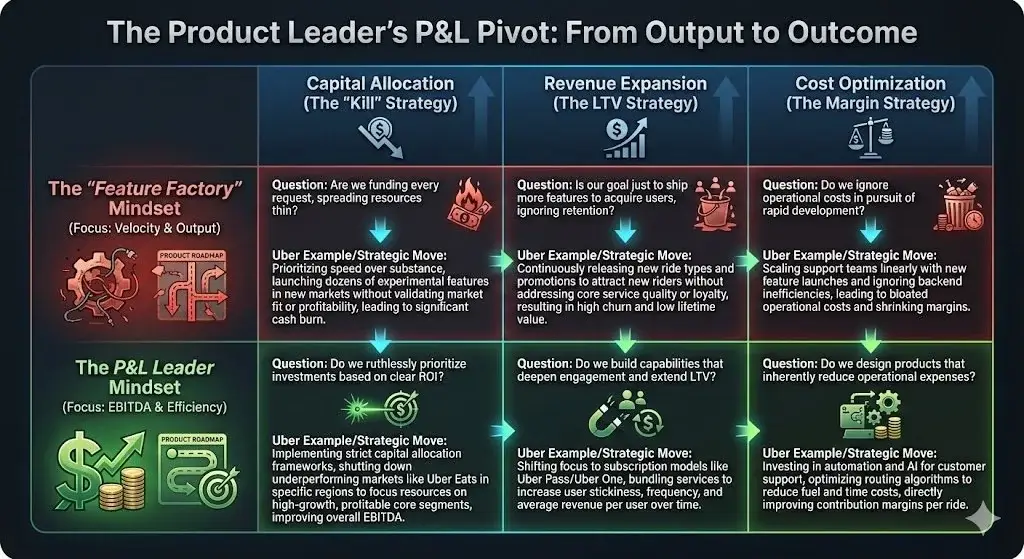
The “Monday Morning” Checklist
If you are presenting your roadmap to the board or your CEO next week, audit your slides against these three questions:
- Capital: Are we funding a “Zombie”? (If yes, kill it).
- Revenue: Does this roadmap increase the LTV of our existing customers?
- Cost: Does this release improve our gross margins?
Great Product Managers build products users love. Great Product Leaders build businesses that last.