
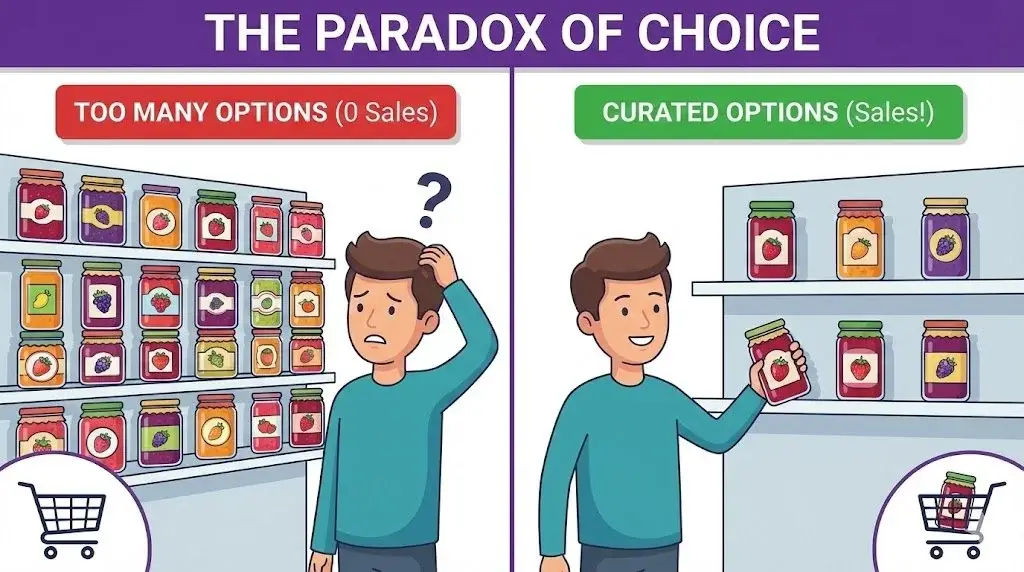
The Paralysis of Abundance
We live in a world of abundance. Walk down the cereal aisle, and you face 50 options. Open Netflix, and you have 5,000 movies. Logic suggests that more options increase the likelihood of finding the “perfect fit.” Psychology proves the opposite: More options increase anxiety.
Barry Schwartz, author of The Paradox of Choice, argues that as options increase, two things happen:
- Analysis Paralysis: It becomes harder to choose.
- Buyer’s Remorse: Even if we do choose, we are less satisfied because we worry that one of the other options might have been better.
The “Rule of 3” in SaaS Pricing
This principle is the holy grail of Pricing Strategy. Look at almost any successful SaaS company (Slack, Zoom, HubSpot). You will rarely find 5 or 6 pricing plans. You almost always find Three.
- Good (Basic)
- Better (Pro)
- Best (Enterprise)
Why 3?
- 1 Option: “Take it or leave it.” (Feels restrictive).
- 2 Options: “Which is better?” (Requires direct comparison, 50/50 split).
- 3 Options: It creates a “Center.” The brain naturally gravitates toward the middle option (The Goldilocks Effect—not too cheap, not too expensive).
If you add a 4th or 5th plan, conversion rates drop because the cognitive load required to compare the features creates friction.
Case Study: The In-N-Out Burger Strategy
Compare the menu of The Cheesecake Factory vs. In-N-Out Burger.
- Cheesecake Factory: A 20-page book with 250 items. It takes 20 minutes to order. The kitchen is complex. Quality varies.
- In-N-Out: Burger, Cheeseburger, Double-Double. Fries. Shakes. That’s it.
In-N-Out has a cult following because the decision is effortless. You don’t have to think; you just eat. They removed the friction of decision-making.
The PM Takeaway: Curate, Don’t Dump
As a PM, your job is not to provide a platform for every possibility. Your job is to be an Editor. You are the expert. You should know what the user needs better than they do.
- Search Filters: Don’t show all 50 filters by default. Show the top 5 that matter. Hide the rest under “Advanced.”
- Onboarding: Don’t ask the user to configure 20 settings. Set intelligent defaults for 19 of them, and ask them to choose 1.
Conclusion
Freedom of choice is a political ideal, but it is a conversion killer. If you want to help your users, stop giving them endless options. Give them a clear path.
The Takeaway: Count the number of choices on your landing page. If it’s more than 3, you aren’t offering freedom. You’re offering homework.