
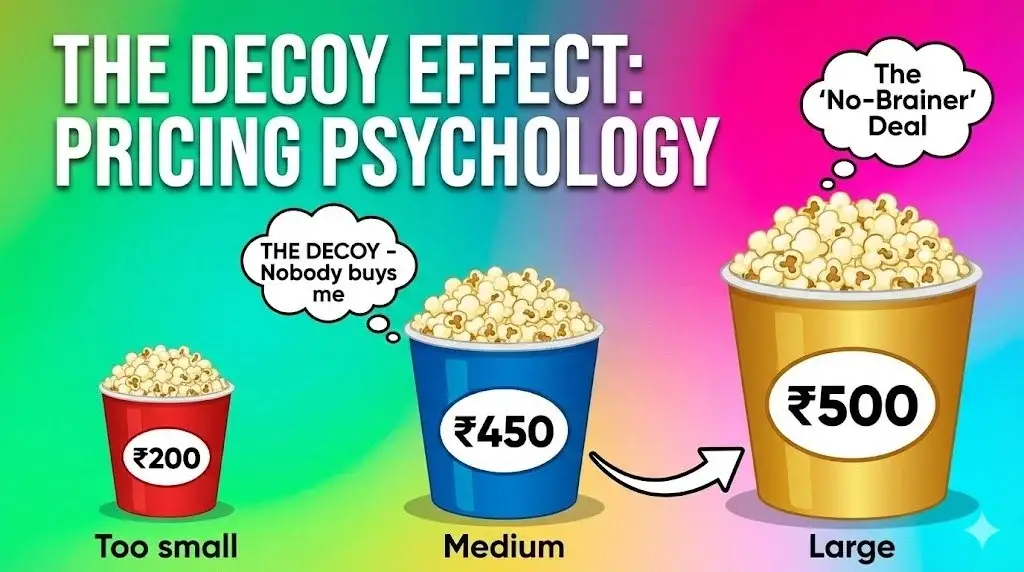
The Rational Shopper Myth
We like to believe we are rational. We think we judge a product’s value based on its intrinsic worth. But behavioral economics tells us a different story: Humans are terrible at evaluating absolute value. We are only good at evaluating relative value.
We don’t know if a subscription is “worth” $50. We only know if it’s “better value” than the $40 option next to it.
The Experiment
This phenomenon was famously demonstrated by Dan Ariely (author of Predictably Irrational) using an Economist magazine subscription offer.
Scenario A (No Decoy):
- Digital Only: $59
- Print + Digital: $125
- Result: 68% chose the cheaper Digital option. Revenue was low.
Scenario B (With Decoy):
- Digital Only: $59
- Print Only: $125 (The Decoy – same price as the bundle, but worse value).
- Print + Digital: $125
- Result: 84% chose the Print + Digital bundle. Revenue skyrocketed.
Nobody chose the “Print Only” option. It was objectively worse. But its mere presence shifted the comparison framework. It made the “Print + Digital” option look like a “free upgrade.”
How to Use It in SaaS
If you are a Product Manager for a SaaS product (or a Micro-SaaS), look at your pricing page.
Do you have a “Good, Better, Best” model? If your goal is to sell the “Better” (Pro) plan, you need a Decoy to push people away from the “Good” (Basic) plan.
The Mistake:
- Basic: $10
- Pro: $50
- Problem: The jump is too high. Users anchor on $10 and feel $50 is expensive.
The Fix (Add a Decoy):
- Basic: $10
- Plus: $45 (Fewer features than Pro, but expensive).
- Pro: $50
- Result: The user compares $45 vs $50. The $50 plan looks like incredible value for just $5 more. The $10 plan is forgotten.
The Ethical Line
Is this manipulation? Yes. Is it illegal? No. It is standard retail psychology. However, as a PM, you must ensure the “Target” option actually delivers value. If you use a decoy to trick people into buying a bad product, you get Churn. If you use a decoy to nudge people into the plan that actually solves their problem best, you get LTV (Lifetime Value).
Conclusion
Pricing is not just math. It is perception management. If you want to sell the Large, don’t lower the price of the Large. Just make the Medium look ridiculous.
The Takeaway: Audit your pricing page. Is every option fighting for a sale? Or do you have a “Wingman” option whose only job is to make the Hero look good?