
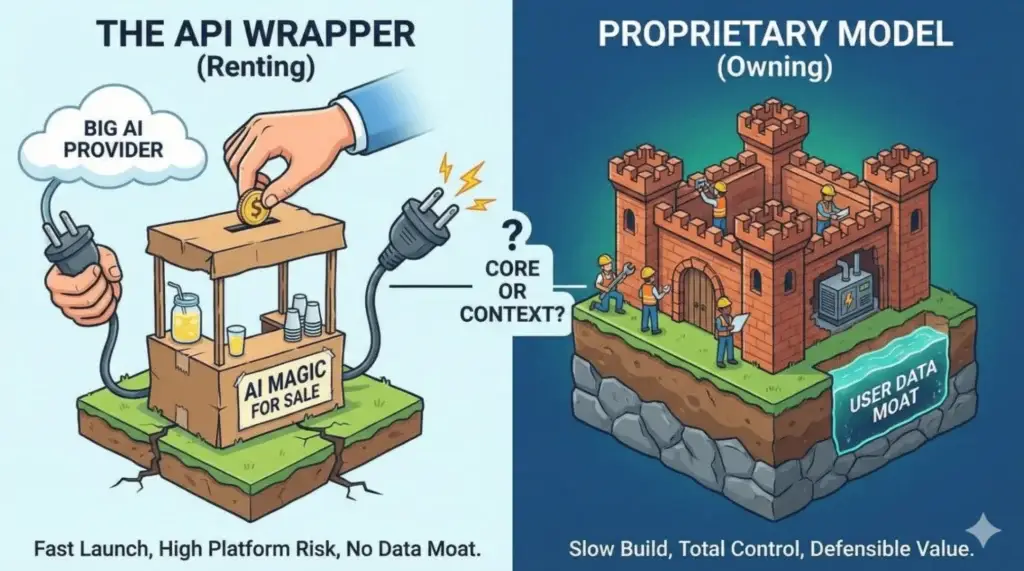
The Illusion of Speed
The allure of the “Buy” option (using foundational model APIs like GPT-4, Claude, or Gemini) is intoxicating. As a Product Manager, you can prototype a magical feature in a weekend. You can launch in a month. You don’t need an army of data scientists. The TTV (Time to Value) is incredible.
It feels like a no-brainer. Why do the heavy lifting when Sam Altman has already done it for you?
The “Landlord Problem”
When you build your product entirely on top of a closed-source API, you are a tenant. The landlord controls the building.
- Margin Compression: When you scale, your API costs scale linearly. There are no economies of scale. The model provider keeps the lion’s share of the margin.
- Platform Risk: Remember when Twitter killed 3rd-party clients overnight by changing its API? That can happen to your AI wrapper. If OpenAI releases a feature that does what you do, you’re dead.
- No Data Moat: You are sending your precious user data to train someone else’s model. You aren’t getting smarter; they are.
The Case for “Build” (Owning the Intelligence)
“Building” in 2025 doesn’t necessarily mean training a massive LLM from scratch. It usually means taking an open-source model (like Llama 3 or Mistral) and fine-tuning it on your proprietary data.
This path is harder. It requires more upfront capital, talent, and infrastructure. But the rewards are strategic:
- Control & Privacy: Your data never leaves your VPC (Virtual Private Cloud). Crucial for enterprise and healthcare clients.
- Cost at Scale: Once trained, running your own specialized model is vastly cheaper than millions of generic API calls.
- A Real Moat: Your fine-tuned model, trained on your unique dataset, is something competitors cannot just clone by getting an API key.
The Framework: Core vs. Context
How do you decide? I use the “Core vs. Context” framework, updated for AI.
- Context (Utility): Is this feature just a necessary utility that doesn’t differentiate you?
- Examples: Summarizing emails, basic chatbots, generic text generation.
- Strategy: Buy (Rent the API). Don’t waste resources building what is already a commodity.
- Core (Secret Sauce): Is this feature your primary value proposition? Is it the reason customers choose you over others?
- Examples: A legal AI trained on 50 years of specific case law; a biotech AI designed for drug discovery.
- Strategy: Build (Own the Model). Your core competency must be owned, not rented.
Conclusion
The “sugar high” of launching an API wrapper is fun. But great companies are built on defensible value.
As a PM, don’t just optimize for the next launch date. Optimize for long-term survival. Don’t let short-term convenience mortgage your company’s future.