
The Complexity Creep
Open Microsoft Word. Look at the toolbar. How many of those hundreds of icons have you clicked in the last year? Maybe 10?
Now open Google Docs. It has perhaps 20% of Word’s features, yet it dominates collaboration. Why?
Because it suffers less from Feature Bloat.
Bloat happens slowly. No PM wakes up and says, “Let’s make our product confusing today.” It happens one rational decision at a time.
- Sales needs Feature A to close a deal.
- Marketing needs Button B for a campaign.
- Engineering wants Setting C for power users.
Individually, these make sense. Collectively, they create a Frankenstein monster.
The “Complexity Tax”
In Product Management, we often forget that features have a negative cost beyond development time.
Every feature you add introduces a “Complexity Tax”:
- Cognitive Load (User Tax): Every new button makes the critical buttons harder to find. New users are overwhelmed and bounce.
- Maintenance Load (Eng Tax): That feature needs to be tested with every release, fixed when it breaks, and updated when APIs change.
- Navigation Load (Design Tax): Your clean menus turn into nested dropdowns five levels deep.
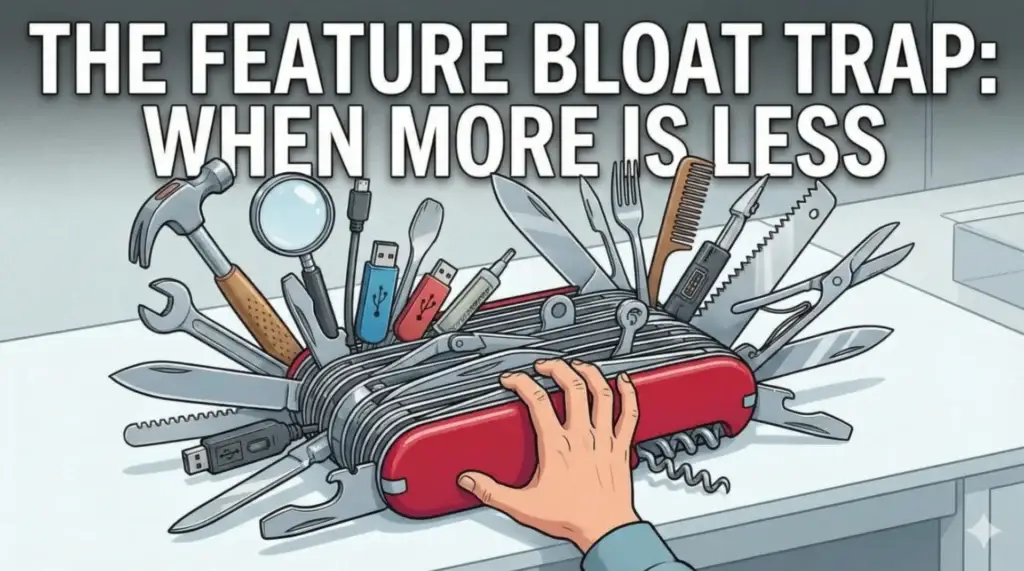
When you try to be everything to everyone, you end up being nothing to anyone. You become a giant Swiss Army Knife—technically capable of doing 50 tasks, but too heavy to carry and terrible at actually cutting anything.
The Incentive Problem
Why is bloat so common? Incentives.
- PMs get promoted for launching new things.
- Engineers get rewarded for building complex systems.
- Sales teams get commissions for saying “yes” to custom requests.
Nobody gets a bonus for saying, “I spent this quarter deleting 15 outdated features to make the app 20% faster.” Yet, that is often the most valuable work a PM can do.
The Solution: Subtraction Strategy
The best product leaders act like editors, not just authors. They know that clarity comes from cutting.
How do you fight bloat?
- The Audit: Identify the bottom 20% of your features by usage. Why are they there? Who are they serving?
- The “Sunset” Process: Don’t just delete them overnight. Communicate with the few users who rely on them, offer alternatives, and then—bravely—kill the feature.
- The “One In, One Out” Rule (Extreme): For mature products, try a constraint: You cannot add a new primary navigation item unless you remove an existing one.
Conclusion
Perfection in product design is not achieved when there is nothing left to add, but when there is nothing left to take away.
The Takeaway: Stop measuring success by how many features you ship. Start measuring success by the clarity and impact of what remains. Be brave enough to subtract.